This is how to burn fat and tone up fast without hours on the treadmill, says personal trainer
When it comes to starting a fitness journey, knowing what the first step should be can be one of the most challenging parts.
Having to filter through endless, conflicting health advice online can be extremely overwhelming, and with new fitness fads constantly popping up, finding the right workout for you can feel like a minefield.
With the busyness of everyday life, most of us simply don’t have time to spend hours a day on a treadmill (or the patience!).
Additionally, pushing yourself to your limits with grueling sessions will leave you feeling both physically and mentally exhausted, and more likely to abandon your fitness journey.
That’s why the key is creating a simple workout plan that fits easily into your weekly routine, gets results, and, most importantly, that you enjoy.
Whether you want to build muscle, boost your endurance, or lose weight, below, we list the exercises that give you the most ‘bang for your buck’, and break down how to do them.
These exercises are suitable for a range of fitness levels (including total beginners), and will enable you to work your whole body, without requiring too much time. Do them consistently and you'll see amazing progress before you know it!
- This is the best low-impact class to burn fat (and it's not Pilates)
- Beginner runners make this mistake - this is how to avoid it

Do at least two strength training sessions per week
If either fat loss or building more muscle is your goal, you’ll want to include strength training in your workout routine.
If you’re trying to lose weight, solely sticking to cardio might feel like a quicker fix, as cardio workouts typically burn more calories than strength training sessions.
However, excessive cardio will cause you to lose muscle as well as fat, as your body will use it for energy, and prevent you from achieving a super toned physique.
According to PureGym, you might actually end up looking ‘skinny fat’, which is a low weight or BMI but a high body fat percentage due to a lack of muscle mass.
This can result in a slower metabolism, make you more susceptible to injury due to weaker muscles, and also put you at a higher risk of developing several medical conditions, including type 2 diabetes, high cholesterol and heart disease.
So the way to prevent your body from eating away at your muscles, and dive into those fat stores instead, is by preserving them through strength training.
Additionally, as muscles expend more energy than fat, you’ll burn more calories simply by having a higher percentage of muscle mass, even when you’re resting.
Strength training also requires extra energy post-workout to repair micro tears to the tissue, which also burns calories, and this can last anywhere from several hours to up to a day.
If you haven’t been the biggest fan of working out in the past, you’ll be pleased to hear that strength training doesn’t have to take up lots of your time.
In fact, just two strength training sessions per week is recommended for beginners, and can effectively change your body composition.

Prioritise compound exercises
The key to spending less time at the gym is by doing compound exercises, which are exercises that work multiple muscle groups and joints simultaneously.
These exercises will allow you to get a full-body workout and prevent imbalances, without having to target each muscle individually.
‘Prioritising exercises that provide a full-body workout allows people to maximise efficiency, burning the most calories per movement. Targeted full-body exercises can build overall strength and fitness, while enhancing mobility and reducing the risk of unnecessary injuries,’ says Mark Harris, Fitness Expert at Mirafit.

Bodyweight squats
Mark offers three key compound exercises for a beginner-friendly workout routine that works every muscle in the body and that don’t require any equipment – so you can do them at home, or at the gym.
The first is the classic bodyweight squat, which uses multiple muscle groups in the lower body – i.e the glutes, hamstrings and quads – as well as the core, and improves flexibility and stability.
While squatting with just your bodyweight is enough to build strength and start seeing results, Mark suggests adding a barbell or kettlebell as your fitness improves. You can add more weight as your strength increases to continue to progress and maximise hypertrophy.
Having the right form is essential to getting the most from the targeted muscles and, more importantly, preventing injury. Follow Mark’s guidance to correctly do the movement:
‘Stand with your feet hip-to-shoulder width apart, brace your core, and lower your hips back and down as if sitting into a chair while keeping your chest lifted. Push through your heels to stand back up and return to the starting position.’

Burpees
Although technically a hybrid exercise, as it gets the heart rate high, the second movement Mark recommends is burpees.
This exercise is fantastic for endurance and strengthens a wide range of muscle groups in the body, including the chest, shoulders, arms, core, glutes, and legs, as well as the heart.
Again, this exercise can be done anywhere; you just need a bit of room to jump and extend into a plank position.
Mark walks us through how to correctly complete a burpee: ‘Begin standing, then squat and place your hands on the floor. Next, jump your feet back into a plank position and then jump forward again. Finally, stand up and perform a small jump to finish.’
‘To increase intensity, beginners can incorporate light handheld weights or use a Mirafit Slam Ball during the jump or overhead extension,’ he suggests.
Glute bridges
The third exercise Mark recommends as part of your full-body workout is glute bridges, which are effective for building your hamstrings, glutes, core, and lower back.
Plus, as an exercise that enhances posture and strengthens the back, glute bridges are ideal for older adults and will help prevent injury.
‘To complete a glute bridge, begin lying on your back with knees bent and feet flat on the floor. Then, pressing through the heels, lift your hips towards the ceiling, squeezing the glutes before carefully lowering back into the starting position,’ says Mark.
Once you’ve nailed bodyweight glute bridges, you can add a barbell to make the exercise more challenging, or try a resistance band.
Simply put the band over your thighs, just above the knee, and push against it while performing the bridge, making sure your legs don’t collapse in.
For that extra burn, increase the time your muscles are under tension by pausing at the top of your glute bridge for a couple of seconds, continuing to push your thighs outwards and holding the squeeze.

Deadlifts
Deadlifts are a powerhouse movement for strengthening your posterior chain, working your glutes, hamstrings, and muscles in your lower back.
There are lots of variations of this exercise, including conventional, sumo, and Romanian.
Romanian deadlifts are particularly well-suited for beginners as they involve a smaller range of motion; they focus on hinging at the hip to target the glutes and hamstrings which allows you to have more control.
Romanian deadlifts are also versatile – you can use either dumbbells, a barbell, or a kettlebell – so choose your preferred piece of equipment and start light, then increase the weight once you're confident.
If you’re totally new, it might be worth practising the hip hinge without weights first to master the movement.
To do a Romanian deadlift, stand with your feet hip width apart, with a slight bend in the knee, and hold your weights as close to your legs as possible with straight arms.
Ensure your spine is neutral, with your shoulders back and down, and that your core is braced.
Then hinge at the hip while lowering the weights – imagine you’re trying to touch the back of the room with your glutes.
When you feel the stretch in your hamstrings (the weights will usually be just below your knee or around the middle of your shin), drive through your feet, squeezing your glutes, to return to your starting position

Push ups
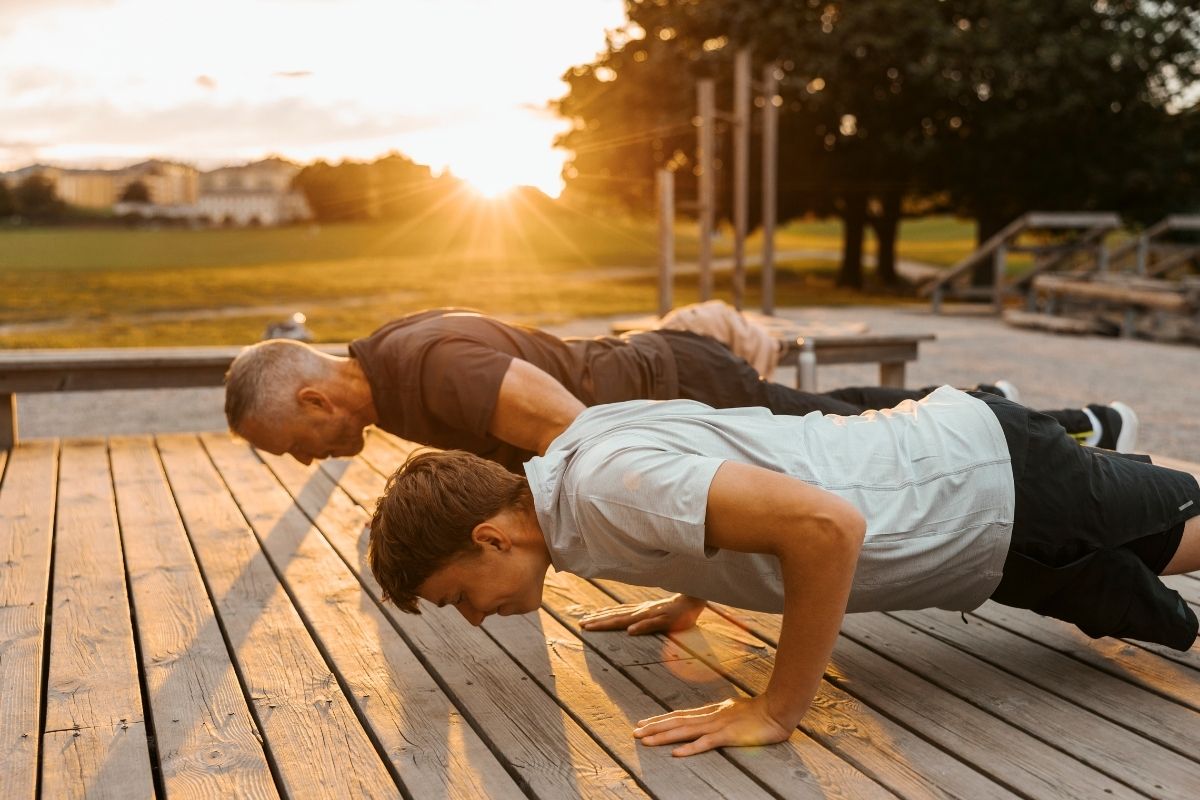
Push ups are another accessible exercise that does not require any equipment, and are great for targeting multiple upper body muscles at the same time – specifically, the chest, shoulders, triceps, and core.
By pairing this exercise with a pull movement that works the back muscles and biceps, such as a bent-over row (spoiler, it’s coming up next), you’ve effectively covered nearly all of the upper body.
Plus, they're easily modified to your fitness level. If full push ups are too challenging, you can try negatives (just lowering yourself down slowly and not pushing yourself back up), incline push ups (pushing off a raised platform such as a bench), or doing the exercise from your knees.
For the most beginner-friendly version of the movement (i.e. knee push ups), start on your hands and knees, with your hands directly under your shoulders and just more than shoulder-width apart.
Move your knees back so from your head to your knees is a straight line and engage your core.
Then, bend your elbows and lower your body down – your chest should end up directly between your hands. Finally, push back up with power.
Bent-over rows
Bent-over rows are the perfect exercise to combine with push ups, as they hit all the opposite muscles, including the lats, rhomboids, traps, and rear delts. You can do these with either dumbbells or a barbell.
Start with your feet shoulder-width apart and with a slight bend in the knees.
With your core engaged, hinge at the hips, as if you were doing a Romanian deadlift, but keep your torso forwards, so it ends up almost parallel with the floor.
Ensure you have a flat back, tucking your chin so you have a neutral spine, and hold the dumbbells or barbell just below your knees.
Then, pulling from the elbow, bring the weights towards your belly, squeezing the shoulder blades together.
Pair cardio with strength training
Although we’ve explained why it’s important not to overdo the cardio, the most effective fitness routines include a combination of cardio and strength training, so you don’t want to neglect it completely either.
As cardio is great for burning calories, it will help put you in a calorie deficit, which is the key to weight loss, if this is your goal.
Cardio strengthens your heart and lungs, making them pump blood and oxygen more efficiently around the body.
With your muscles receiving more oxygen, you will be able to perform better and recover more quickly during exercise – improving your endurance.
Many forms of cardio are a fantastic full body workout, too. Exercises such as high-intensity interval training (HIIT), swimming, and rowing all use lots of the major muscles, so they’ll help you achieve an all-around toned physique.
If swimming or rowing isn’t accessible to you, or you find going to the gym intimidating, there are plenty of HIIT workouts available on YouTube, so you can do them from the comfort of your home.
Skipping is another effective cardio exercise that uses muscles in your legs, core and shoulders, and all you need is a rope.
And don’t dismiss walking! It’s low impact, so it’ll put less strain on your joints, and beginner-friendly, but it still burns calories and will allow you to build up your endurance.
Plus, it encourages you to get outside and disconnect from screens, which is beneficial for your mental health as well as your physical health.
But arguably the best thing about cardio is that it releases endorphins, which will make you feel amazing – and isn’t that what exercise is supposed to be all about?
Read more: